 Home
Home- About H&V
- Resources
- Services
- Chapters
-

Download The Functional Listening Evaluation from this page
The purpose of the FLE is to determine how listening abilities are affected by noise, distance, and visual access in a student’s everyday listening environment. The FLE can also be used as a validation tool to demonstrate the benefits of hearing assistance technology. It is designed to simulate listening ability in situations that are representative of typical classrooms and other settings than cannot readily be replicated in sound booth assessment. Through observation of the administration of the evaluation, the student’s teachers, parents, and others may gain appreciation of the effects of adverse listening conditions encountered by the student. When comparing performance without and with the addition of hearing assistance technology such as an FM system, the evaluation results provide evidence of the benefits of the device in enhancing access to the desired input. The FLE format may also be useful in justifying other accommodations, such as sign language or oral interpreting, note-taking, captioning, special seating, and room acoustic modifications. This protocol is based on a listening paradigm suggested by Ying (1990), and by Ross, Bracken, and Maxon (1992).
The student’s classroom should be utilized during a time when students are not present. If the student has multiple classrooms choose the one where most speaking and listening instruction occurs or where there is concern regarding communication access. If one of the student’s classrooms is not available, choose a room that most closely approximates the size, ambient noise level, and floor and wall surfaces of the student’s classroom. While performance during actual class sessions would seem ideal, the test process itself may be disruptive to instruction for the rest of the class and therefore may not reflect the true listening conditions encountered by the student throughout the day.
Due to room size and instructional style variations, the occupied classroom should be observed to determine maximum listening distances. Record this as the “far” distance on the Summary and Interpretation Form. When setting up for the close conditions, measure the 3 foot distance from the student’s ear to the examiner’s mouth.
Close: Noise and examiner are 3 feet in front of the student (see Diagram A).
Far: Noise remains 3 feet in front of the student; the examiner moves back to the pre-determined distance (12 to 15 feet in this example) from the student (see Diagram B).
Diagram A |
Diagram B |
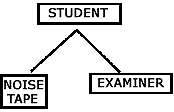 |
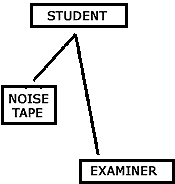 |
Updated 2013 by C.D. Johnson. Based on Functional Listening Evaluation by C.D. Johnson & P. Von Almen, 1993. Available from www.ADEvantage.com.
In order to simulate classroom listening ability, the speech evaluation material utilized should be developmentally appropriate and approximate material that is encountered by the student in the classroom. Additionally the stimuli should have sufficient length to reflect reverberation characteristics of the room. Consideration should also be given to both familiar and new material that a student may encounter. Individuals will usually perform better with familiar material than with stimuli containing unfamiliar vocabulary. Students with unilateral and mild hearing losses tend to perform well under all conditions.
Age, language competency, and memory abilities of the individual should also be considered when determining the test stimuli. In selecting word, phrase or sentence materials, consider whether the vocabulary and syntax are appropriate for the student’s language level. For students with poor speech intelligibility, as well as young children, it may be necessary to use materials that incorporate picture-pointing responses. If closed-set materials are utilized, performance can be expected to be better than with open-set materials. Once the type of stimuli is determined, it must remain constant throughout the assessment so that the variables manipulated are noise, distance, and visual input. Report the material used on the Summary and Interpretation Form. Common materials include are listed below. In many of these materials there will not be sufficient lists for the entire protocol (8 lists are needed). If it is necessary to use a list twice, select the lists that were more difficult for the student in order to reduce familiarity with the material. The Common Children’s Phrases and the Children’s Nonsense Phrases each contain eight lists of twenty phrases and provide the option of phrase or word scoring.
| Sentence Materials: | BLAIR Sentences |
WIPI Sentences |
| Phrase Materials: | Common Children's Phrases | Children’s Nonsense Phrases |
| Word Lists: | PB-K NU-6 |
|
| Picture – Closed Set: | WIPI, NU-CHIPS | |
| Note: The Common Children’s Phrases and Nonsense Phrases are available in the Educational Audiology Handbook (2nd Ed.) (Johnson & Seaton, 2012) as well as the author’s website: www.ADEvantage.com; word and sentence lists should be available from most pediatric and educational audiologists. | ||
The Recorded Functional Listening Evaluation Using Sentences (Johnson & Anderson, 2013) is now available on CD from https://successforkidswithhearingloss.com. This version utilizes 5-word HINT-C (Hearing in Noise Test for Children) sentences that were based on the original Bamford-Kowal-Bench (BKB) sentences (1979). Half of the sentences are recorded in quiet and the other half with a +5 SNR and follow the condition presentation order of the FLE. This version simplifies presentation of the FLE by eliminating the need for a noise file and adjusting noise and speech sound levels; however the SNR cannot be altered. Additional instructions are provided with the CD.
The conditions of close/far and auditory/auditory-visual are presented in quiet (4 presentations) and then in noise (4 presentations) to achieve the total of eight conditions. Speech to noise ratio levels (SNR) should be based upon the auditory environments encountered by the students in their classrooms. Sound level measurements of classroom discourse and activity may be necessary to determine these levels. For this example, the levels will achieve values resulting in a +5 dB speech advantage in the close conditions and a –5dB speech to noise ratio in the far conditions (12-15ft). Levels will vary slightly depending upon the acoustics of the room and consistency of the examiner’s voicing of the stimuli. Measure and record the classroom ambient noise level (unoccupied), approximate teacher or talker levels, and noise levels as directed on the scoring form.
Speech: Calibrate the examiner’s voice at a distance of 3 feet from the listener (close condition). Ask the student to hold the SLM to their ear and the examiner to talk measuring the examiner’s voice with the sound level meter so that speech averages 65dBA SPL at the listener’s ear. Once that level is measured, check the SPL level when the sound level meter is held one foot from the examiner’s mouth (being careful to keep the voice level the same) so that the examiner can hold the sound level meter to monitor his/her voice for all conditions to verify that the proper speech level is maintained. The level at 1 foot from the examiner will be approximately 3 dBA SPL greater that at the listener’s ear for close conditions).
Noise: Locate the noise source 3 feet from the student and adjust the volume of the noise source (classroom/multitalker noise) using a sound level meter, so that the noise averages 60 dBA SPL at the student’s ear. This yields a +5 speech-to-noise ratio level.
The FLE should be conducted in the student’s typical hearing mode. If hearing aids or cochlear implants are usually worn at school, they should also be worn during the evaluation. When this evaluation is used as a validation tool to demonstrate improvement in listening ability with FM or other hearing assistance technology, the examiner should repeat the far conditions to demonstrate the benefits of the technology.
Eight phrase, sentence or word lists should be presented in the order indicated by the numbers on the scoring matrix. This order balances for difficulty across conditions so that the final task is the easiest of the far conditions.
The examiner may choose to alter the order for other reasons however.
| 1. | Auditory-Visual | Close Quiet |
| 2. | Auditory | Close Quiet |
| 3. | Auditory-Visual | Close Noise |
| 4. | Auditory | Close Noise |
| 5. | Auditory-Visual | Far Noise |
| 6. | Auditory | Far Noise |
| 7. | Auditory | Far Quiet |
| 8. | Auditory-Visual | Far Quiet |
When presenting the FLE via live voice, the examiner should present the speech materials at a normal speaking rate. Instruct the student to repeat the speech stimuli or point to the appropriate picture, as indicated by the material used. Repeat far conditions (9-12) to validate benefit of hearing assistance technology. Test administration takes approximately 30 minutes, including set up. For the auditory conditions it is recommended that the examiner use an acoustically transparent hoop over his/her face or instruct the student to look down during these conditions as placing a hand or paper in front of the talker’s mouth will change the acoustic characteristics of the speech sounds.
Scoring should be completed using the established procedures for the selected test material. Scoring may be made on total phrase/sentence correct or by number of words correct. In some situations it is useful to have another person (such as the classroom teacher) score the speech test materials. All scores should be reported in percent correct in the Scorebox on the Summary and Interpretation Form. Hearing assistance technology scores should be entered in the boxes labeled 9-12 for the far conditions repeated. A calculable PDF FLE form is available that populates the interpretation matrix from the Scorebox at www.ADEvantage.com.
This protocol is based on the listening situation of a typical classroom. For an individual student, it may be useful to modify this protocol to account for variations in the level and source of noise, classroom size, teacher’s voice, typical listening distances for the student, or other factors. In order to accommodate these variations placement of the noise source, level of noise, distance from the student in the far condition, and order of presentation may be adjusted. Be sure to note these modifications on the test form.
The Interpretation Matrix analyzes the effects of noise, distance, and visual input. It is completed by transferring the scores from the Scorebox to the same numbered box in the interpretation matrix. Individual scores are summed and averaged to determine the overall effect of each condition. Although scores may be affected by different speakers, rate of speaking, attention of the listener, or status of amplification, comparisons are valid as long as these variables are kept constant throughout the evaluation.
When validating hearing assistance technology, the target for desired performance is the score from box 1 (for auditory visual) or box 2 (auditory only) of the Scorebox. In other words, the effects of noise and distance can be considered eliminated when the performance with the technology matches the individual’s best performance in quiet, or at least reduced, if the performance is improved. This information can be used as evidence to justify technology and other accommodations that may be beneficial for the student. The findings should be discussed with the student, his/her parents, and teachers to help them understand the student’s listening abilities and communication accommodations options. A summary of the Interpretation Matrix and appropriate recommendations should be written on the scoring form.
Updated 2013 by C.D. Johnson. Based on Functional Listening Evaluation by C.D. Johnson & P. Von Almen, 1993.
Johnson, C.D. (2012). Common Children’s Phrases, Children’s Nonsense Phrases, In Educational Audiology Handbook (2nd Ed.) (150-153). Clifton Park, NY: Delmar Cengage Learning..
Johnson, C.D. (2013). Functional Listening Evaluation. Available from www.ADEvantage.com
Johnson, C.D. & VonAlmen, P. (1993). The Functional Listening Evaluation. In Educational Audiology Handbook, (336-339). Johnson, Benson, & Seaton (1997). San Diego: Singular Publishing Group, Inc.
Ross, M., Brackett, D. & Maxon, A. (1991). Communication Assessment. In Assessment and management of mainstreamed hearing-impaired children (113–127). Austin, Tx: Pro-Ed.
Ying, E. (1990). Speech and Language Assessment: Communication Evaluation. In M. Ross (Ed.), Hearing-impaired children in the mainstream (45–60). Parkton, MD: York Press.
Download this article as a pdf with the Interpretation form - Found originally at http://adevantage.com/Resources
Download the Functional Listening Evaluation & Children’s Phrases at http://adevantage.com/Resources
QUICK LINKS