Reasons to Say Yes to Assessments in Early Intervention for your Child who is Deaf/Hard of Hearing
1. Don’t Guess: Assess!
Assessments help you and your IFSP* team create a unique plan and set goals that are important to you and your family. Assessments build a “map” for the plan so you know where to focus as you help your child grow and develop in these early years – the fastest years of development!
2. Set the Bar High
Assessments help you discover and build on your child’s strengths and gifts. Discussing strengths and needs will help you see how your child is developing compared to children of the same age. You will know if and in what areas your child needs extra support for play skills, concepts and language.

3. Take Your Place on the Team
Family involvement is the key to future success. Actively learning about your child through assessments helps you stay on top of their growing abilities to communicate, understand, and express their feelings and thoughts. Professionals and families working and problem-solving together are unstoppable.

4. Confirm Your Intuition
Your gut instincts as a parent should be taken seriously. They are part of the mix of what you know to be true about your child. Assessments can quantify your feelings about where your child needs to grow. Completing assessments every six months and monitoring regularly can catch any developing issues. This allows you and your team to change the plan together if needed to better meet your child’s needs.
5. Smooth the Transition to Preschool
You will have a current, full picture of your child’s strengths and needs to share with the new team as your child transitions to school. How does your child communicate best? Where will your child benefit from additional support? What are their strengths? You’ll have insights to share at the eligibility meeting which leads to strong suggestions for goals and services. You’ll be more confident working with the school team with the knowledge you have gained.

*IFSP means Individual Family Service Plan, the plan for services for your child who is under age three within Early Intervention. For more information, contact fl3@ handsandvoices.org, your state or territory’s Part C Coordinator or a local Early Intervention provider.

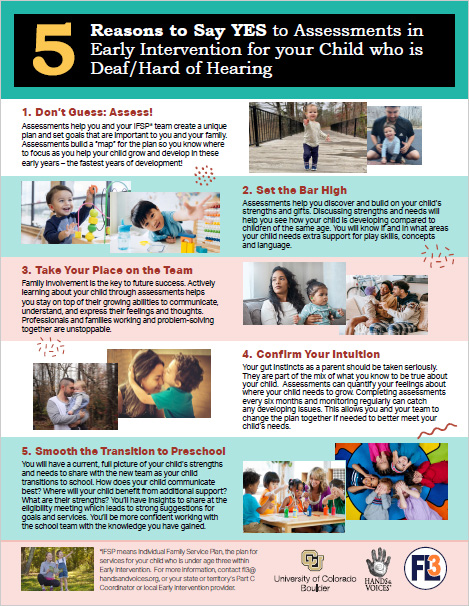
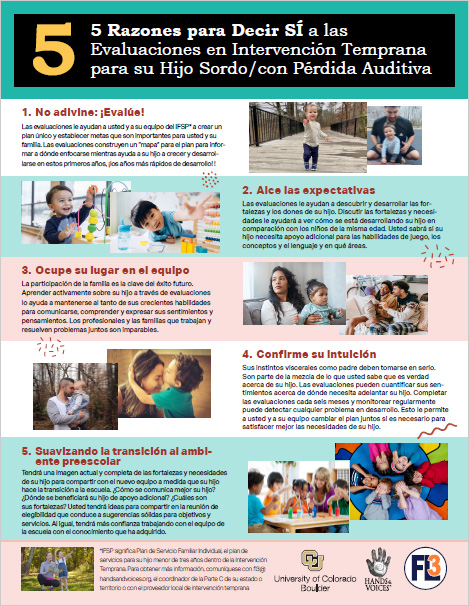
Purpose of this resource: To share information about five positive outcomes of holistic assessments of children who are deaf/ hard of hearing in early intervention. This infographic is intended to help reach families about the importance of ongoing assessment in early intervention. Developed by family leaders for new families, this infographic points families in a positive way with their early intervention team in those first valuable years.
Family support providers and educators can share or print this visual aid to assist in introducing assessments with information by experienced families. Assist in giving families a vision of their role as their child’s best advocate in early intervention and beyond. Thanks to our partners at the University of Colorado Boulder and the Michigan Department of Education Resource for Deaf/Hard of Hearing (MDE RDHH) and LEAD-K Michigan for their support of this project.